
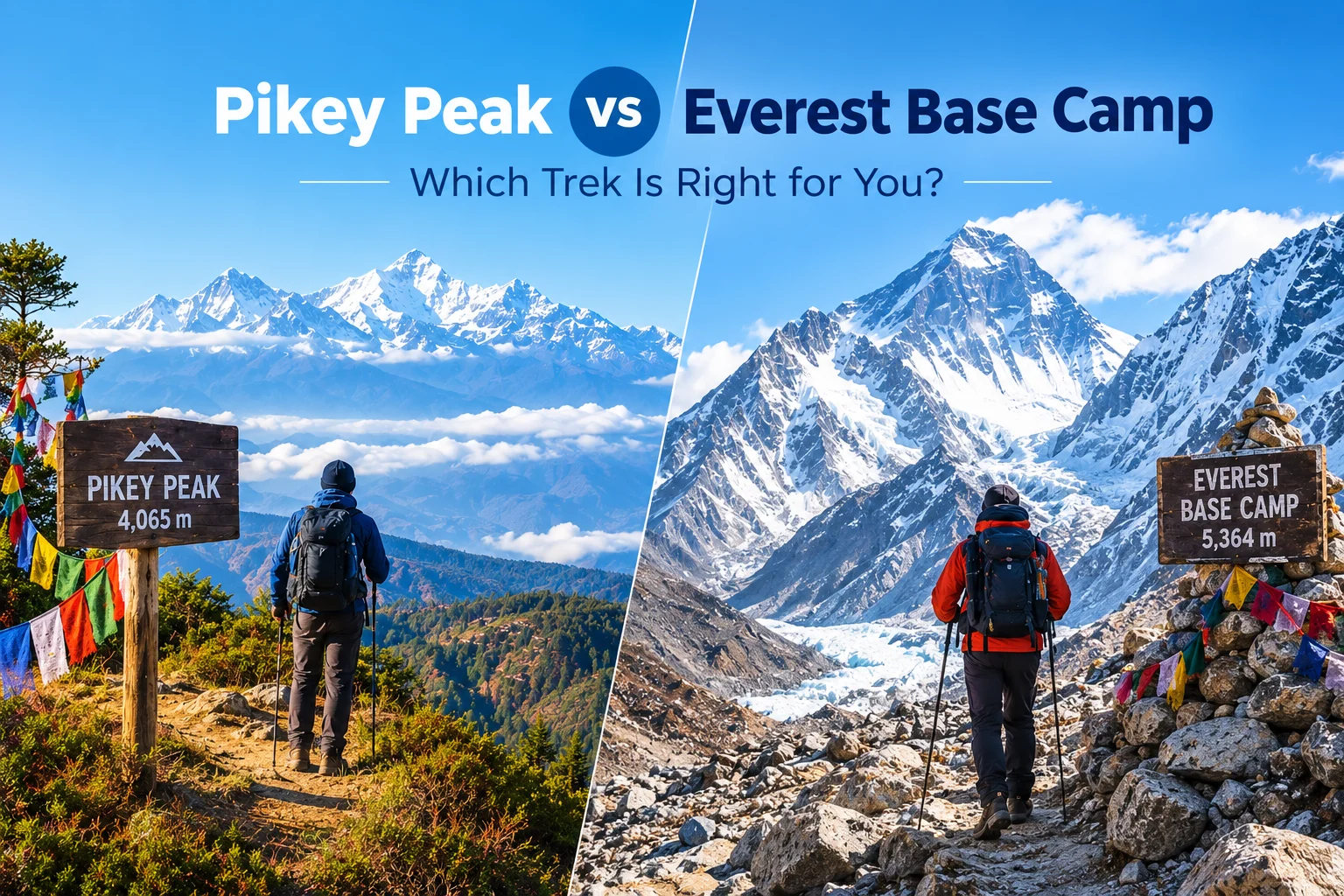
Most people who compare Pikey Peak and Everest Base Camp are not really asking which trek is better. They are asking something more practical: can I see Everest without two weeks off work, without sleeping above 5,000 metres, and without the Lukla flight?
The answer is yes. Pikey Peak does all three. But there is one honest trade-off, and we will get to it straight away.
Last verified September 2026. Permit rates and flight prices in Nepal change without much warning, so we have flagged where sources disagree instead of quoting one number as fact.
The short answer
-
Choose Pikey Peak if you have about a week, are new to high altitude, want quiet trails, or do not want to gamble your itinerary on a Lukla flight.
-
Choose Everest Base Camp if standing at the foot of Everest is the whole point, and you have 12 to 16 days plus the budget for it.
The trade-off: Pikey Peak gives you a better view of Everest. Everest Base Camp gives you the arrival. You cannot have both on one short trip.
Pikey Peak vs Everest Base Camp: full comparison
|
Metrices |
Pikey Peak Trek |
Everest Base Camp Trek |
|
Trek days |
4 to 9 (6 is common) |
12 to 16 |
|
Highest point |
4,065 m |
5,364 m (5,545 m at Kala Patthar) |
|
Difficulty |
Moderate, no technical sections |
Moderate to strenuous |
|
Getting there |
Drive from Kathmandu to Dhap |
Flight to Lukla, or long overland route |
|
Lukla flight |
Not needed |
Needed, or add 4 to 6 days by road |
|
Acclimatisation days |
Usually none |
Two, at minimum |
|
Altitude sickness risk |
Low |
Real, and routinely underestimated |
|
Crowds |
Very few trekkers |
Heavy in October and April |
|
Everest view |
Wide panorama, Everest clearly visible |
Close range, Everest partly hidden |
|
Region |
Solu, lower Solukhumbu |
Khumbu, upper Solukhumbu |
|
Teahouses |
Basic, family run, few options |
Well developed, bakeries and wifi |
|
Guided package |
Roughly USD 500 to 800 |
Roughly USD 1,300 to 1,800 |
Why the altitude difference matters more than the numbers suggest
Pikey Peak tops out at 4,065 m. Everest Base Camp sits at 5,364 m, and nearly everyone who goes there also climbs Kala Patthar at 5,545 m for the actual Everest view.
That gap of roughly 1,300 m changes the whole trip.
At Pikey Peak height:
-
Most people feel normal, or mildly breathless on climbs
-
You sleep and eat properly
-
No acclimatisation days are built in, which is why the trek is short
-
Serious altitude sickness is uncommon
Above 5,000 m on the EBC route:
-
Broken sleep and poor appetite are the norm, not a warning sign
-
Headaches are common even when you are acclimatising correctly
-
Two rest days are standard, and skipping them is how people get into trouble
-
Some trekkers turn back at Lobuche or Gorak Shep after paying for the whole trip
This is the part most comparison content skips. The EBC risk is not that walking is hard. The walking is manageable. The risk is that your body may simply refuse to cooperate at altitude, and no amount of gym work beforehand guarantees otherwise.
Pikey Peak removes that gamble almost entirely.
The Lukla flight problem, and why Pikey Peak avoids it
This is the single biggest practical difference, and it is the reason a lot of people end up choosing Pikey Peak.
What happens on the EBC trek:
-
In peak season, Lukla flights often shift to Ramechhap Airport because Kathmandu airport is too congested. That means a road transfer of four to five hours before you even fly.
-
Mountain weather cancels flights regularly. Trekkers lose days waiting, sometimes several.
-
A cancelled return flight can mean missing an international connection, or paying for a helicopter out.
What happens on the Pikey Peak trek:
-
You drive from Kathmandu to Dhap. Roads can be slow, but they do not get cancelled.
-
The common version ends with a short flight from Phaplu back to Kathmandu, and Phaplu is a far less weather-dependent airstrip than Lukla.
-
If that flight is delayed, you can still drive out.
There is a whole category of Everest treks marketed as "EBC without the Lukla flight," but almost all of them are 16 to 21 day overland itineraries. If you do not have three weeks, those are not really an option. Pikey Peak is the short answer to the same problem.
Which trek has the better Everest view?
This surprises people. Pikey Peak wins.
From Everest Base Camp, you are looking at the Khumbu Icefall and the walls of Nuptse and Lhotse. Everest itself is largely blocked by the ridges in front of it. That is why almost every itinerary adds the pre-dawn climb up Kala Patthar, which is where the postcard view actually comes from.
From Pikey Peak summit, you get an open panorama that on a clear morning includes:
-
Everest
-
Kanchenjunga
-
Makalu
-
Lhotse
-
Numbur, Thamserku and the Gaurishankar range
Sir Edmund Hillary is widely quoted as saying Pikey Peak had the finest view of Everest in Nepal. That line appears on nearly every operator's page, so treat it as folklore rather than a sourced quote. The geography holds up regardless. Pikey sits far enough back from the Khumbu that nothing stands between you and the skyline.
What Pikey Peak cannot give you is the feeling of standing at the base of the mountain. If that moment is what you have been imagining for years, no viewpoint substitutes for it. Be honest with yourself about which one you actually want.
Where Pikey Peak actually is (and why Everest region is misleading)
Pikey Peak is in Solu, the lower part of Solukhumbu district. Everest Base Camp is in Khumbu, the upper part.
Most websites call Pikey Peak an Everest region trek. It is technically the same district, but it is not the Khumbu, and the difference is not cosmetic:
-
Pikey Peak is outside Sagarmatha National Park
-
It does not touch the Lukla trail
-
The permit requirements are completely different
-
The culture is Sherpa, but rural and farming based, not trekking-economy based
If a site tells you Pikey Peak is in the Everest region without explaining that, it is blurring something that affects your permits and your expectations.
Permits and costs in 2026
Everest Base Camp permits
Two permits, both checked on the trail:
|
Permit |
Fee (foreign nationals) |
|
Sagarmatha National Park entry |
NPR 3,000 (about USD 23) |
|
Khumbu Pasang Lhamu Rural Municipality |
NPR 3,000 (about USD 23) |
|
Total |
NPR 6,000 (about USD 45) |
The TIMS card is not used in Khumbu. It was replaced by the local municipality permit. If anyone charges you for TIMS on a standard Lukla to EBC trek, question it.
Flagged conflict: sources disagree on when the Khumbu permit rose from NPR 2,000 to NPR 3,000. Some say September 2024, others say during 2025. The current rate of NPR 3,000 is consistent across sources, so use that and ignore the history.
Flagged conflict: Lukla flight prices vary wildly across operator sites for 2026, from roughly USD 188 one way out of Ramechhap to USD 257 quoted as a round trip. Budget USD 400 to 520 return, and get the figure in writing from your operator rather than trusting any published number, including ours.
Pikey Peak permits
This is genuinely messy online, so here is the plain version.
It depends on where you start.
Starting at Dhap, ending at Phaplu (the most common route): you generally do not enter the Gaurishankar Conservation Area. A local area permit of around NPR 2,000 is what applies.
Starting at Jiri or Shivalaya: you do cross into the Gaurishankar Conservation Area, so the GCAP at NPR 3,000 is required.
Flagged outdated information: many Pikey Peak pages state flatly that the Gaurishankar permit is mandatory for all routes. That is wrong for the Dhap route. Some also list TIMS as compulsory, while others say it has not been required here since 2020. The honest position is that TIMS status on this trail is inconsistent, and enforcement varies. Carry the cash for it and let your guide sort it at the office.
There is no national park fee for Pikey Peak, because the route stays outside Sagarmatha National Park.
Rough cost comparison
|
Item |
Pikey Peak |
Everest Base Camp |
|
Permits |
USD 15 to 40 |
About USD 45 |
|
Transport |
Jeep, plus one-way Phaplu flight |
Lukla flight return, USD 400 to 520 |
|
Trek days paid for |
4 to 9 |
12 to 16 |
|
Guided package |
Roughly USD 500 to 800 |
Roughly USD 1,300 to 1,800 |
Permits are the smallest line on both treks. The real cost difference is days on the trail and the Lukla flight.
A licensed guide has been required on Nepal's national park trekking routes since April 2023. Budget for it on either trek.
Numbers you will see online that are wrong or out of date
Worth knowing before you compare operator pages:
-
"TIMS card required for EBC." Outdated. Replaced by the Khumbu municipality permit.
-
"Khumbu permits NPR 2,000." Outdated. It is NPR 3,000 now.
-
"Gaurishankar permit required for Pikey Peak." Only true from the Jiri or Shivalaya side.
-
"Pikey Peak is 4,070 m." Minor, but 4,065 m is the figure used most consistently.
-
"Kala Patthar 5,555 m." You will see both 5,545 m and 5,555 m. The difference does not affect anything.
-
Any Lukla flight price older than one season. These move constantly.
Crowds and what the trail actually feels like
Everest Base Camp in October: teahouses fully booked, queues at the suspension bridges, porters and trekkers moving in a steady line. Namche Bazaar has bakeries, gear shops and coffee. The infrastructure is excellent and the atmosphere is busy.
Pikey Peak in October: you may walk for hours without meeting another trekker. Teahouses are family homes with a few rooms.
The honest downside of Pikey Peak:
-
Fewer lodges, so limited choice if one is full
-
Simple menus, mostly dal bhat, noodles and eggs
-
Basic bathrooms, patchy hot water, unreliable charging
-
Very little English signage on the trail
If comfort matters more to you than solitude, Khumbu genuinely does it better. That is not a small point, and anyone telling you Pikey Peak is better in every way is selling rather than advising.
Who should choose which trek
Pikey Peak suits you if:
-
You have 5 to 8 days in Nepal
-
This is your first Himalayan trek
-
You are trekking with older parents or children
-
You are nervous about flying into Lukla
-
You want the mountain views more than the destination
-
Your budget is under about USD 900
Everest Base Camp suits you if:
-
You have 14 days or more
-
Reaching base camp itself is the goal
-
You have been to altitude before and handled it
-
You want good lodges and a lively trail
-
You can absorb 2 to 4 lost days to flight delays
Can you do both?
Yes, it is a reasonable plan.
-
Pikey Peak first, EBC later. Pikey works as a genuine test of how you handle moderate altitude and multi-day walking, on a trip that stands on its own.
-
Combined itinerary. Some operators run Pikey Peak into the classic Jiri route through to EBC. Expect 18 to 20 days and strong fitness.
-
Pikey Peak this trip, EBC next trip. The most common real-world outcome, and there is nothing wrong with it.
Frequently Asked Questions
Is Pikey Peak easier than Everest Base Camp?
Yes, clearly. It is shorter, about 1,300 m lower at its highest point, and needs no acclimatisation days. The walking is still four to seven hours a day on hill trails, and the summit climb is steep and cold before dawn.
Can you see Mount Everest from Pikey Peak?
Yes. On a clear morning the summit view includes Everest, Kanchenjunga, Makalu and Lhotse. The view of Everest is more open than the view from Everest Base Camp itself, where nearer ridges block much of the mountain.
Do you need a Lukla flight for the Pikey Peak trek?
No. You drive from Kathmandu to Dhap to start. The usual version flies out from Phaplu, which is far more reliable than Lukla, and driving out is always an option.
How many days is Pikey Peak compared to EBC?
Pikey Peak runs 4 to 9 days, with 6 being common. Everest Base Camp runs 12 to 16 days including acclimatisation. With flight delays, EBC realistically needs a buffer on top.
What permits do you need for the Pikey Peak trek?
It depends on the route. From Dhap to Phaplu, a local area permit of around NPR 2,000 applies. Starting from Jiri or Shivalaya adds the Gaurishankar Conservation Area Permit at NPR 3,000. No Sagarmatha National Park permit is needed either way.
Is Pikey Peak worth it if you cannot do Everest Base Camp?
It is worth doing on its own terms, not as a consolation. You get a wider Himalayan panorama, quieter trails and real village culture, for roughly half the cost. What you give up is standing at the base of Everest.
Is Pikey Peak in the Everest region?
It is in Solukhumbu district, but in Solu, not Khumbu. It sits outside Sagarmatha National Park and does not connect to the Lukla trail. Calling it the Everest region is loose shorthand.
Still deciding?
If the Pikey Peak side of this comparison sounds like your trip, our 6 day Pikey Peak Trek drives up to Dhap and flies back from Phaplu, with no Lukla flight anywhere in the itinerary. See the full Pikey Peak Trek itinerary.
If you want to understand the wider area first, our Solu region guide covers how Solu differs from Khumbu and what else is worth trekking there.
