
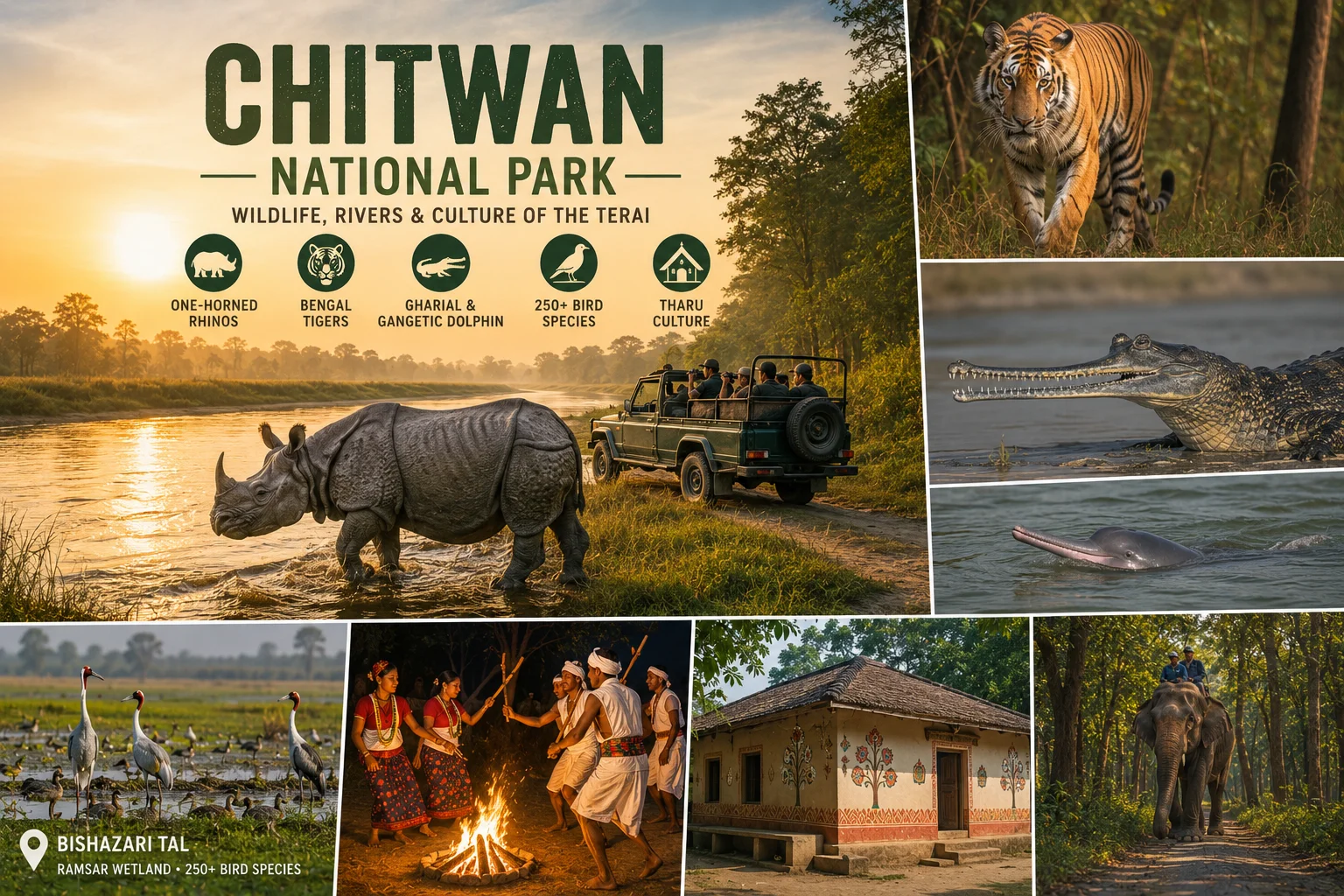
Nepal is famous for its mountains. Chitwan has nothing to do with mountains, and that is exactly the point.
Sitting in the flat Terai lowlands of south-central Nepal, Chitwan National Park is the country's first national park, established in 1973 and declared a UNESCO World Heritage Site in 1984. It covers 952 square kilometers of dense sal forest, open grassland, riverine jungle, and oxbow wetlands, bordered naturally by the Rapti and Narayani rivers to the north and west. After a week in the Himalayas, Chitwan feels like a different planet.
The rhino story
In the late 1960s, fewer than 100 one-horned rhinos were left in the entire country. Poaching, deforestation, and habitat loss had pushed the species to the edge. The creation of Chitwan National Park changed that. The 2021 national census counted 694 one-horned rhinos inside Chitwan alone, making it the second largest population of this species on earth after India's Kaziranga National Park. The global total of one-horned rhinos is around 4,000. Roughly one in six of them lives here.
On a jeep safari in Sauraha, your chance of seeing one in the wild is over 90 percent. You will often see several in a single morning.
Tigers
The 2026 National Tiger Survey, released on July 29, 2026, confirmed 145 Bengal tigers in and around Chitwan National Park, the highest count in any single protected area in Nepal. Nepal's total tiger population has now reached 429, up from 355 in 2022. Spotting a tiger is a different story, though. They live here, but the sal forest is dense and tigers move on their own terms. On a standard three-day safari, your realistic chance of a sighting is around 10 to 15 percent. Go knowing that, and you will not be disappointed. The forest feels alive regardless of whether a tiger appears.
Everything else in the water
The Rapti and Narayani rivers that run along the park boundary are worth as much attention as the jungle. The gharial, a fish-eating crocodile with a long, narrow snout, is one of the most ancient-looking creatures on earth and one of the most endangered. Chitwan runs a dedicated Gharial Breeding Centre near the park headquarters, where eggs are hatched in controlled conditions and juveniles are released into the rivers. On a canoe ride down the Rapti at dawn, a gharial sighting is almost guaranteed. The Gangetic dolphin, one of only four freshwater dolphin species in the world, is also present in the Narayani.
Bishazari Tal
Most visitors never make it here, which is a loss. Bishazari Tal, which translates to "twenty thousand lakes," is an oxbow lake system inside the park and a designated Ramsar wetland covering 7,900 acres. Over 250 bird species have been recorded here. Sarus cranes, storks, kingfishers, and migratory ducks arrive between December and February. For birdwatchers, it is one of the finest wetland sites in South Asia.
Tharu culture
The Tharu people have lived in the Terai for generations, long before the national park existed. Their villages sit along the buffer zone on the park's edge. The architecture is distinctive, with low mud-and-wattle homes with painted walls. The food is different from hill Nepali cooking, heavier on fish and local spice. Tharu stick dancing, performed around fires in the evenings in Sauraha, is one of the most well-known expressions of their culture. A village walk through a Tharu settlement gives you a side of Nepal that has nothing to do with trekking or temples.
Getting there and the seasonal guide
|
Metric |
Details |
|
Base Camp |
Sauraha, a lively tourist village situated on the northern bank of the Rapti River. |
|
Park Entry Fee |
NPR 2,000 per day for foreign nationals (usually valid for a single entry). |
|
By Air |
A 25-minute flight from Kathmandu to Bharatpur Airport, followed by a 30-minute taxi drive to Sauraha. |
|
By Overland Bus |
5 to 6 hours from Kathmandu by tourist bus. Note: Expect delays on the Narayanghat-Mugling stretch due to ongoing road widening projects. |
Quick Cost & Activity Breakdown
|
Activity |
Timing |
Estimated Cost (Per Person) |
|
Jeep Safari |
6:00 AM (Half-Day) |
NPR 2,500 – 4,000 (Shared) |
|
Canoe Ride |
Dawn (90 mins) |
NPR 1,500 – 2,500 |
|
Guided Jungle Walk |
2 – 4 hours |
NPR 2,500 – 4,000 (Armed guides) |
|
Elephant Breeding Center |
1 hour |
NPR 50 (Foreigners) |
Best time to visit: October to March for cool, dry weather and shorter grass that makes wildlife easier to spot. Late February to April is particularly good after the annual grass cutting, when visibility through the forest floor opens up and animals come to waterholes. April and May are hot but excellent near water sources. Avoid the height of the monsoon (June to August) when trails flood and road access becomes unreliable.