
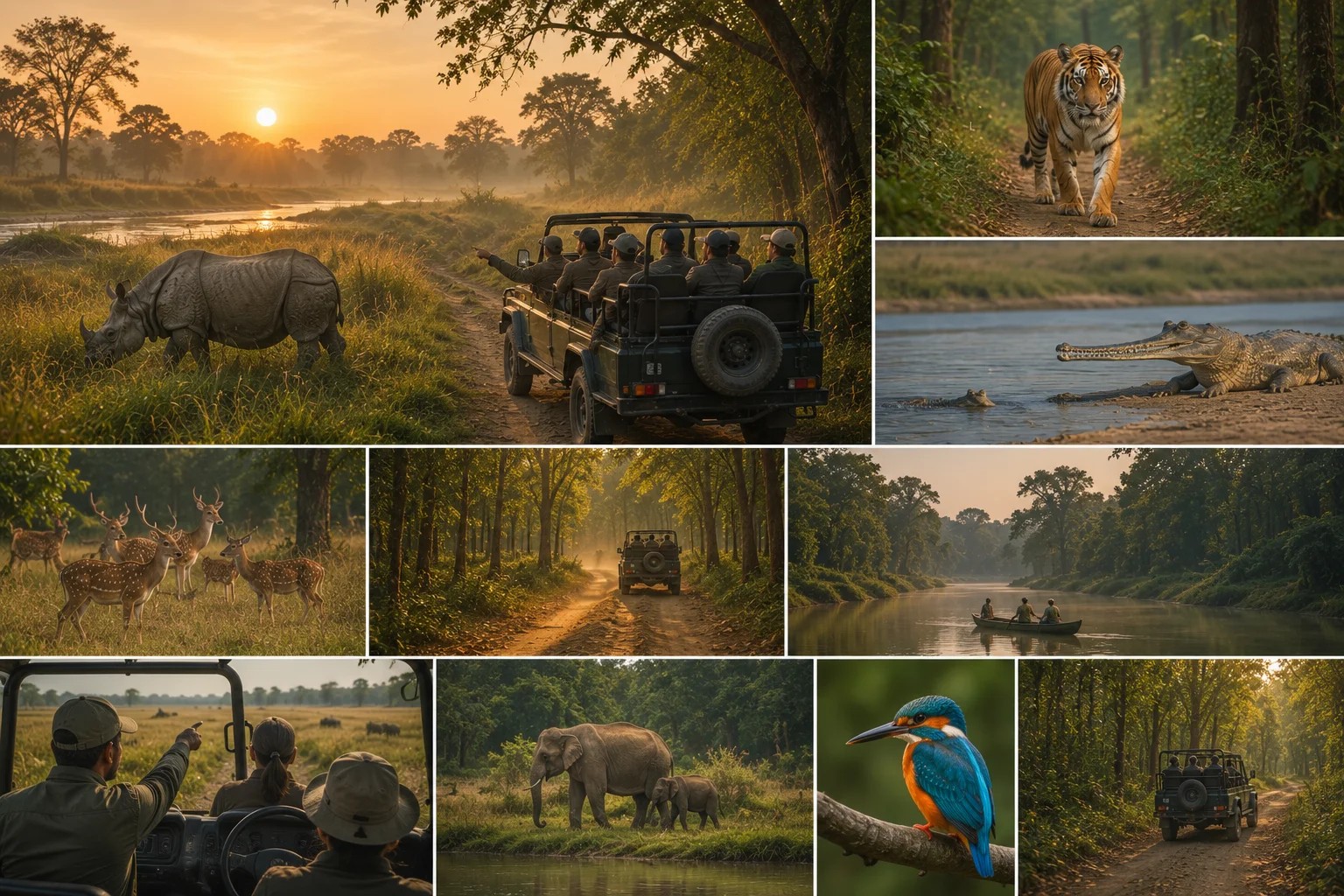
6am. Mist on the grass. Your guide raises a hand. Everyone stops talking.
Forty meters away, a one-horned rhino steps out of the tall grass, looks at the jeep, and keeps eating. That is what a morning jeep safari in Chitwan looks like on a normal day. Not a lucky day. A normal one.
How it works
An open-sided 4WD carries six to eight people with a driver and a licensed naturalist guide through the park's core zone. The jeep has no roof and no sides, which means unobstructed views in every direction. Your guide sits up front and reads the jungle as you move through it, pointing out tracks, identifying bird calls, and stopping the vehicle whenever something is worth watching.
What makes Chitwan jeep safaris particularly effective is that guides across the park share sightings over radio in real time. If a rhino is grazing three kilometers east, every jeep in the area knows within minutes. That network is one of the main reasons sighting rates here are so high compared to other parks in South Asia.
The park has over 200 kilometres of jeep tracks running through three types of terrain: open grassland where rhinos graze and deer are everywhere, dense sal forest where light comes through in patches and tiger tracks show up in the mud, and riverine woodland along the Rapti and Narayani where crocodiles sun themselves on the banks.
Half day vs full day
A half-day safari runs for four to five hours and covers roughly 40 to 60 kilometers. You enter the park at 6am, move through the core zone, and return by late morning. This is what most visitors do, and it is enough to see the park properly on a two-night stay.
A full-day safari runs around eight hours and covers up to 100 kilometers, going deeper into zones that half-day jeeps rarely reach. A packed lunch is eaten inside the park. If seeing less-visited parts of the forest matters to you, or if you are serious about tiger tracking, the full day is worth it.
Morning or afternoon
Morning is better. Animals are most active before the heat sets in, overnight tracks are still fresh and readable, and the light is good for photography. The morning slot starts at 6am.
The afternoon slot starts at 2pm and runs until sunset. Animals behave differently in the late afternoon, and the golden light is good for photos, but sighting rates for large mammals are
lower than in the morning. If you are doing two days, do morning both days. If you only have one slot, pick morning.
What you will actually see
One-horned rhinos: your chance of seeing one on a morning jeep safari is over 90 percent. The 2021 national census counted 694 rhinos in Chitwan alone, and they move openly through the grassland. You will most likely see more than one.
Spotted deer, sambar deer, hog deer, and barking deer are near-certain on any safari. Wild boar and langur monkeys are common. Gharial and mugger crocodiles are regularly spotted near river crossings.
Bengal tigers: the 2026 national tiger survey confirmed 145 tigers in and around Chitwan, the highest count in any single protected area in Nepal. Spotting one on a jeep safari is a different matter. The sal forest is dense, and tigers move on their own terms. On a three-day visit, your realistic chance of a sighting is around 10 to 15 percent. That is honest. Go knowing that and the safari will not disappoint. Go expecting a tiger, and it might.
Sloth bears, leopards, and wild elephants are present in the park and possible sightings, but not common on any given day.
Shared or private jeep
A shared jeep carries six to eight passengers and costs NPR 2,500 to 4,000 per person for a half day. It is the right option for solo travelers, couples, and anyone on a budget. You move at the guide's pace and share sightings with whoever is in the jeep.
A private jeep costs NPR 10,000 to 15,000 for the whole vehicle regardless of how many people are in it. It makes sense for families, groups of four or more, and photographers who want to stop longer at a sighting or request a specific route. The guide focuses entirely on your group.
What to wear and bring
Wear neutral colors. Brown, grey, and dark green. No white, red, or bright patterns. Animals notice contrast and movement, and bright clothing disrupts sightings for everyone in the jeep.
Closed shoes are necessary. Sandals are not suitable inside the park. Bring a light jacket for morning departures between October and February when temperatures near the river drop sharply before sunrise. Binoculars make a significant difference, especially for birds and distant sightings. If wildlife photography matters to you, bring a zoom lens. Your phone camera handles close-range rhino encounters fine but struggles with anything in the tree line.
Drones are not permitted inside Chitwan National Park.
Best time
October to March is the most reliable window. Weather is dry, grass is shorter after the annual cutting in late January, and animals are easier to spot in open terrain.
Late February to April is the best period for tiger sightings. Water sources dry up and animals including tigers concentrate near rivers and waterholes, which the jeep routes cover well. Temperatures in April reach 38 to 40 degrees Celsius by midday but early morning safaris remain excellent.
Avoid June to September. The monsoon floods most park roads, safari routes are restricted to the buffer zone, and visibility through the regrown grass drops significantly.
Park entry fee
NPR 2,000 per day for foreign visitors. The fee is charged per day you enter the park, not per activity. If you do a jeep safari and plan to do a canoe ride or jungle walk, stack them on the same day and you pay the entry fee once.